Thinking tools made operational.
Inquiry treats your AI coding assistant as a finite state machine with a declarative transition contract. The CLI enforces pre- and post-conditions. The point is not to deny model quality, but to make AI-assisted work legible through explicit thinking tools, orchestration, and memory.
This page is a public explainer. For the canonical repository doctrine, see docs/architecture.md and docs/spec/finite-ape-machine.md.
The operational cycle
The current operational model is a six-state cycle. IDLE is the entry and exit, and DEWEY owns its bounded triage mission. ANALYZE, PLAN, and EXECUTE are the core work phases. END is the explicit PR gate. EVOLUTION is opt-in. The forward flow is linear; backward edges from PLAN and EXECUTE to ANALYZE exist because re-analysis is legal, not a recovery hack.
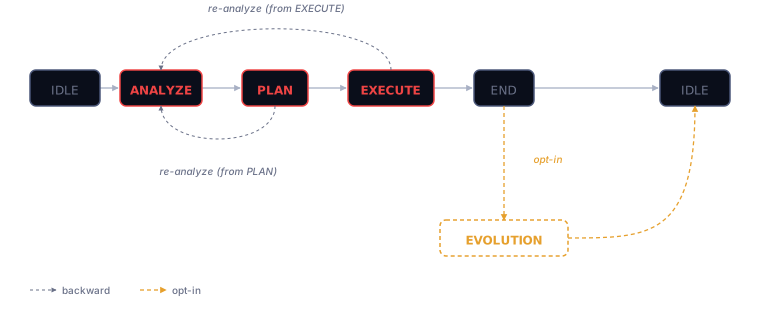
IDLE· DEWEY- Bounded issue triage. DEWEY determines whether the situation is ready to become or select a GitHub issue;
inquiry-startperforms the explicit handoff into ANALYZE. ANALYZE· SOCRATES- Clarifies the problem through dialog. Produces
diagnosis.md. The handoff gate requires every Evidence bullet to carry a re-checkable handle — afile:line, URL, or inline-code reference — so each claim can be reopened, not just asserted. PLAN· DESCARTES- Divide, order, verify, enumerate. Produces
plan.md, where every phase must carry an executable acceptance check (a test-runner command or a test file), not pseudocode. EXECUTE· ADA- Programming as explicit construction under a coding manifesto. Produces code and commits.
END· PR gate- Opens and merges the pull request via
gh. No agent; the CLI orchestrates. EVOLUTION· DARWIN opt-in- Reads the cycle's artifacts and proposes mutations to Inquiry itself. Off by default.
The transition contract
Transitions aren't code — they're data. A YAML file declares every legal transition, its trigger event, its prechecks, and its effects. The CLI reads this file at runtime and refuses any transition the contract doesn't permit.
# code/cli/assets/transition_contract.yaml (excerpt)
transitions:
  - from: ANALYZE
    to: PLAN
    event: complete_analysis
    prechecks:
      - diagnosis_exists
      - diagnosis_evidence_verifiable  # every Evidence bullet has a re-checkable handle
      - issue_linked
    effects:
      - set_state: PLAN
      - invoke_agent: DESCARTES

  - from: PLAN
    to: ANALYZE
    event: start_analyze
    # backward transition: re-analysis is legal
    prechecks:
      - human_approval
This is the core artifact. It's what makes Inquiry portable across hosts and tools: every agent reads the same contract and can only produce the transitions it permits. If a future host (Claude, Codex, Gemini) processes a different prompt, the contract constrains the output shape identically.
Memory as code
Inquiry keeps repository knowledge in plain files, not a hosted memory service. Repo-scoped configuration lives in .inquiry/; cycle-scoped state and artifacts live in cleanrooms/<branch>/.
.inquiry/ — repo-scoped configuration
config.yaml— feature flags and runtime preferencesmetrics*.yaml— repository-scoped metrics surfaces when enabled- Settings shared across cycles, hosts, and future runs
cleanrooms/<branch>/ + docs/ — cycle state and project knowledge
.iq.state.yaml— current FSM state and last transition for the active cycleanalyze/diagnosis.md,plan.md,run_trace.yaml, andmutations.mdhold the cycle evidence- ADRs, specs, and runbooks in
docs/hold the long-term project memory - Indexed by the agents via the
doc-readskill index.mdper directory acts as a primary index- Structured YAML and durable markdown keep the same evidence legible to the host, the agent, and the reviewer
Database-inspired indexing without a database. Directories are tables. Files are rows. Frontmatter is the schema. index.md is the primary index. An agent with grep is more than an agent with a vector store for this scale of knowledge. Dual legibility: the same file an agent reads is the same file you review in GitHub. No translation layer.
The risk matrix
Spec-only today. The idea: iq fsm transition should gate on human approval only when the engineering risk warrants it. Low-risk mechanical transitions (scaffolding, formatting, test scaffolding) proceed silently. High-risk ones (schema changes, production deploys, external API mutations) demand explicit approval.
Why thinking tools matter
AI makes philosophical discipline operational again.
Inquiry is not trying to prove that a weaker local model can beat a frontier hosted one. The aim is stricter: make AI-assisted engineering legible, auditable, and portable by grounding it in explicit thinking tools. If providers change, prices move, or hosts churn, the doctrine should survive because the discipline lives in the method, not in one vendor surface.
The thesis Inquiry exists to test is philosophical and methodological: AI-assisted software work improves when questioning, decomposition, verification, and evolutionary learning are turned into operational method. The evidence lives in a metrics.yaml dataset that doesn't fully exist yet — the reproducibility score sits at 2/10 until 30 clean cycles and a multi-host test matrix land. See the historical bootstrap thesis, APE builds APE →.
Go deeper
Meet the agents →
The five active agents in the live roster, and the larger cast that collapsed.
Bootstrap thesis: APE builds APE →
The historical bootstrap story and the evidence it produced, without making APE the current product name.
Read the architecture →
The canonical system-level explanation of APE as the orchestrating methodology.
Read the spec →
The formal specification, referenced throughout this page.